Using data collected during the fast-sampling phase of the SWOT satellite, a study published on Journal of Geophysical Research: Oceans shows that fine-scale eddies (<100 km) in the Northwestern Mediterranean Sea are as efficient as large and intense structures found in western boundary currents and the Antarctic Circumpolar Current system in transferring wind energy into the ocean interior. These findings might apply to the rest of the global ocean characterized by low energy and thus provide a new challenge to parameterize this process in Earth system models.
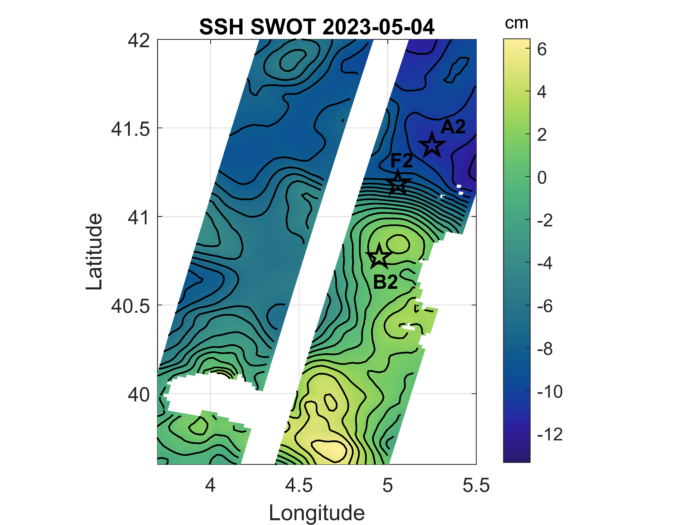
SWOT sea surface height measurements show an anticyclonic eddy that was not visible with nadir altimetry. SWOT data were acquired during stations B2 (located inside the anticyclonic eddy), station locations are indicated with black stars. Credits: Rolland et al. 2026
The paper “Near-inertial wave trapping inside a fine-scale anticyclonic eddy during the BioSWOT-Med 2023 cruise: turbulence and energy flux” published on Journal of Geophysical Research: Oceans investigates how fine scales control the spatio-temporal variability of turbulence around the North Balearic Front, which is a fine-scale front in a moderately energetic area in the Northwestern Mediterranean Sea.
The work used data from track #3 of the SWOT satellite during its 1-day repeat orbit in the spring 2023, as well as in situ data gathered during the BioSWOT-Med cruise. The authors examined the evolution of turbulence when the front experience strong wind events. The study shows that fine-scale eddies are as important as larger eddies in modulating ocean turbulence, in particular when trapping near-inertial waves.
An adaptive sampling strategy informed by near-real time SWOT data
The BioSWOT-Med cruise implemented an adaptive in situ sampling strategy that combined Lagrangian and Eulerian measurements to target a fine-scale frontal area. Near-real time satellite data of sea surface height from SWOT satellite as well as gridded nadir altimetry and wind reanalysis data were used to inform the cruise trajectory and helped identifying the sampling stations. In situ data (microstructure measurements, CTD measurements and stratification, horizontal currents) were collected using ship-based observation platforms as well as drifters and gliders.
Based on ship thermosalinograph data, three different water masses were identified in the proximity of the front: water mass “A”, situated in a cyclonic area with saltier and cooler water north of the front; water mass ”B” south of the front and corresponding to an anticyclonic area with fresher and warmer waters; water mass ”F” corresponding to the frontal area separating A and B. The anticyclonic area is dominated by an eddy well captured by SWOT.
The combination of fortuitous meteorological events and the synoptic oceanographic situation, with an anticyclone visible in SWOT observations but too small to be detected by nadir altimetry SSH maps, created an ideal occasion to explore for the first time the interactions between near-inertial waves and an eddy at fine scales. In particular, the study investigates how a small eddy can trap near-inertial waves and thus propagate their wind-derived energy at depth into the water column.
Fine-scale eddies can trap near-inertial waves and transfer wind energy into the ocean interior
“In this study, the Balearic front separates a fine-scale anticyclonic eddy from a cyclonic area. Near-inertial waves are generated at large scale but are only trapped in the anticyclonic eddy. The front acts as a barrier for the near-inertial wave propagation. While the near-inertial waves propagate at depth into the eddy, they generate vertical shear that in turn leads to enhanced turbulence. On the other side of the front the absence of trapping (and then, of near-inertial wave propagation) explain the absence of turbulence enhancement” says Robin Rolland, post-doctoral researcher at the University of Bremen and first author of the study.
The study found that fine-scale eddies are efficient for trapping near-inertial waves and driving vertical fluxes of energy below the mixed layer. “In the past, this process of trapping has been observed in large anticyclonic eddies (ones that nadir altimetry could capture) or studied in idealized numerical studies. In principle, to be trapped, the near-inertial waves should be smaller than the anticyclonic eddy. In this study, we show that this process also occurs in smaller (fine-scale) anticyclonic eddy, for which the size of the near-inertial waves can be similar. Among previous observations of this process, only a few provided microstructure measurements, and even less provided vertical energy flux estimations, which are both important to quantify its effect on the mixing and the ocean energetics. We were able to provide both in this study” says Rolland.
The fraction of the vertical kinetic energy flux to the wind power input into inertial motions (WPI) is a crucial metric to quantify the input of energy from the wind forcing to the deep ocean. Rolland and colleagues were able to calculate that the near-inertial waves studied during the BioSWOT-Med cruise were able to carry 20% of the wind energy at a depth of 60 m and 8% of the wind energy at a depth of 210 m. These values are comparable with the few previous estimates in much larger eddies.
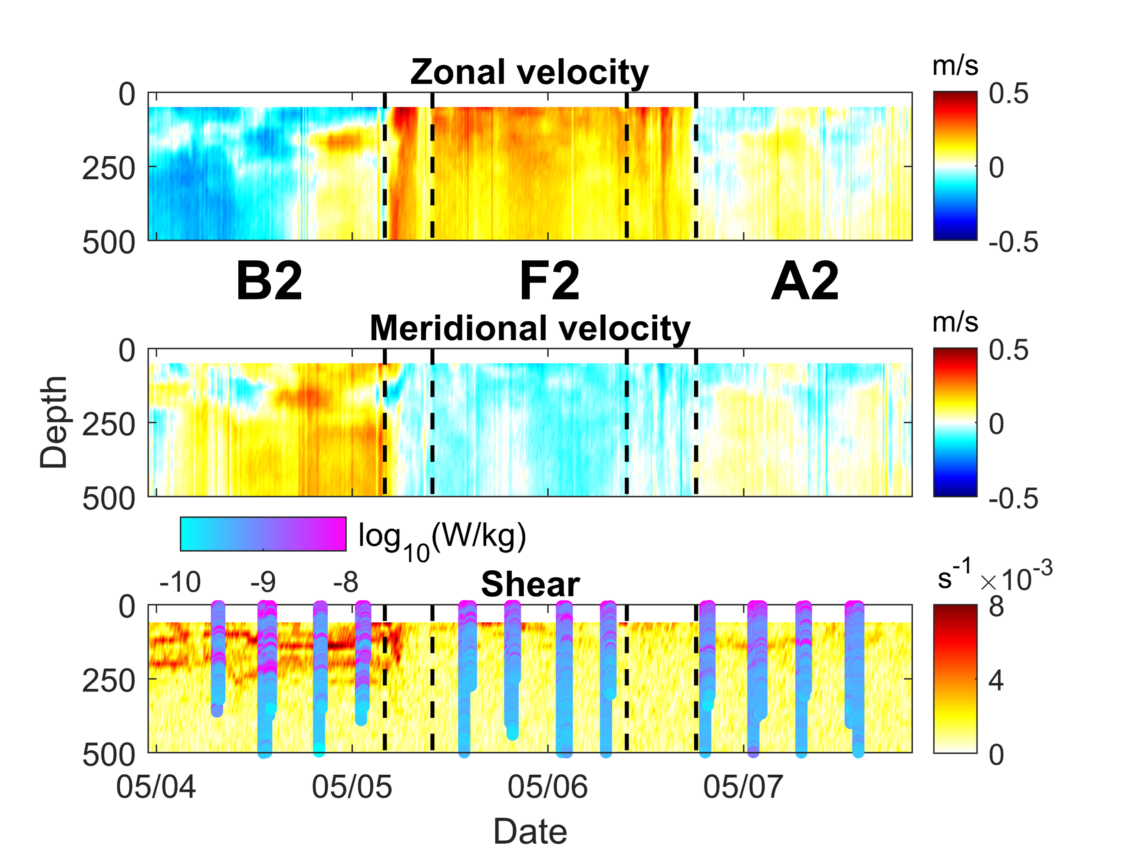
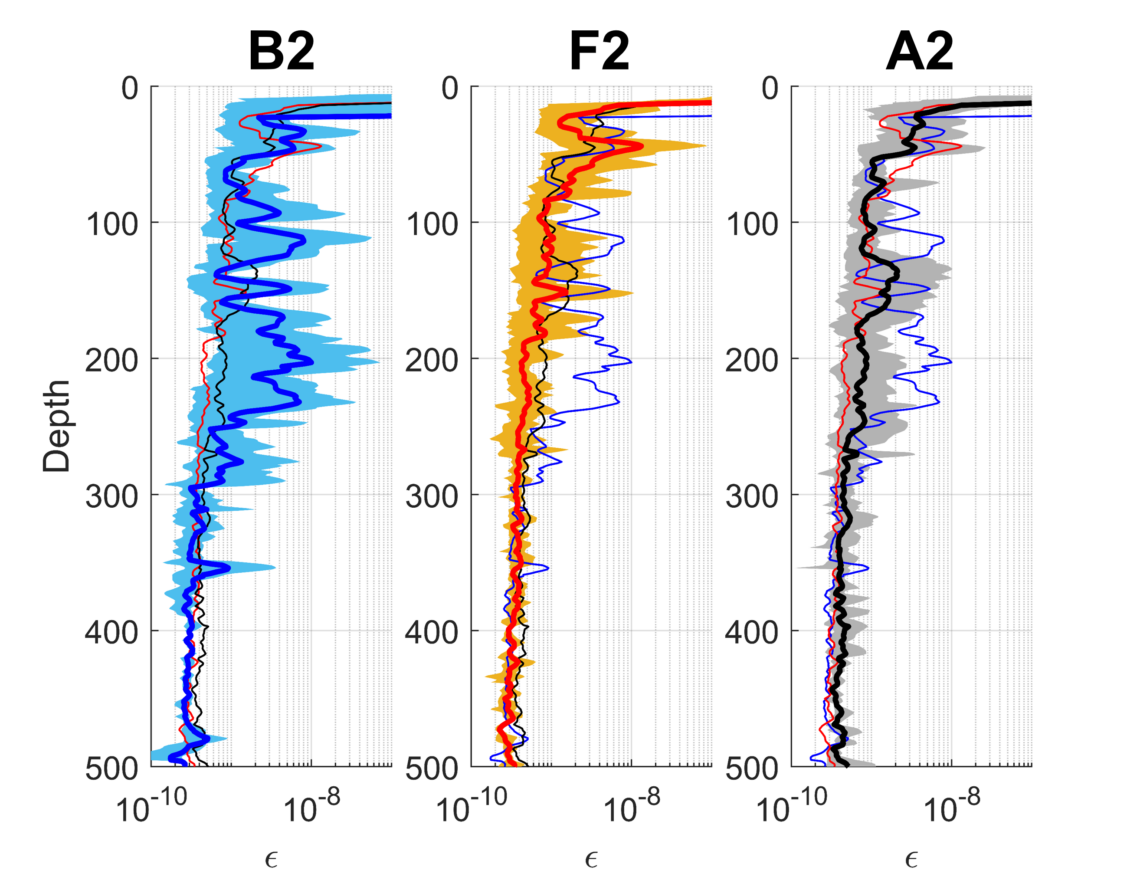
(Left) Trapping of the near internal wave in the eddy. Ship-ADCP 38 kHz velocities and shear during stations B2, F2 and A2. Superimposed on the shear is the dissipation rate of turbulent kinetic energy measured by the Vertical Microstructure Profiler. Vertical dashed line indicate transits from stations B2 to F2 and F2 to A2. A strong near-inertial wave signal is visible in the first 250-300 m at B2. The trapping is highlighted by the abrupt drop in shear between B2 and F2. (Right) Increase in dissipation in the eddy compared to the front zone and the cyclonic area. Station-averaged profiles of the dissipation rate and min-max range (shaded area). The dissipation is increased by one to two orders of magnitude down to ~250 m at B2 compared to F2 and A2. Credits: Rolland et al. 2026.
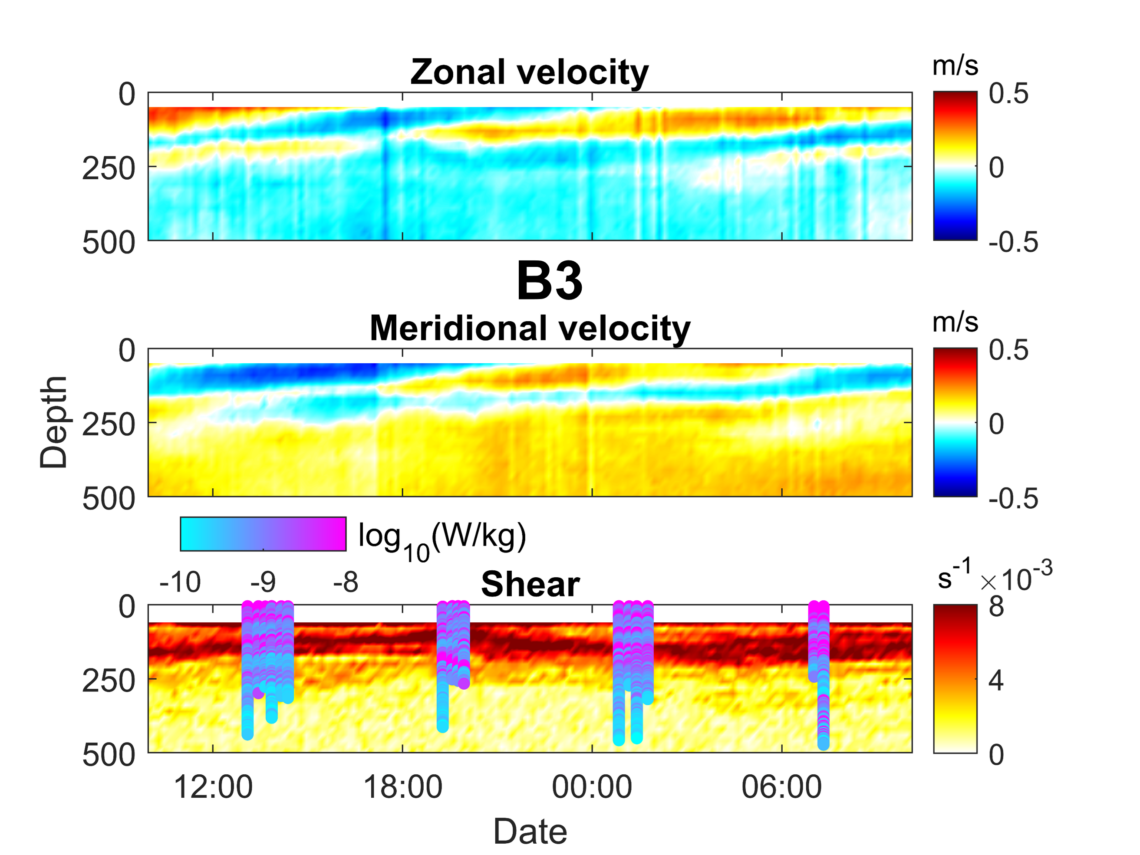
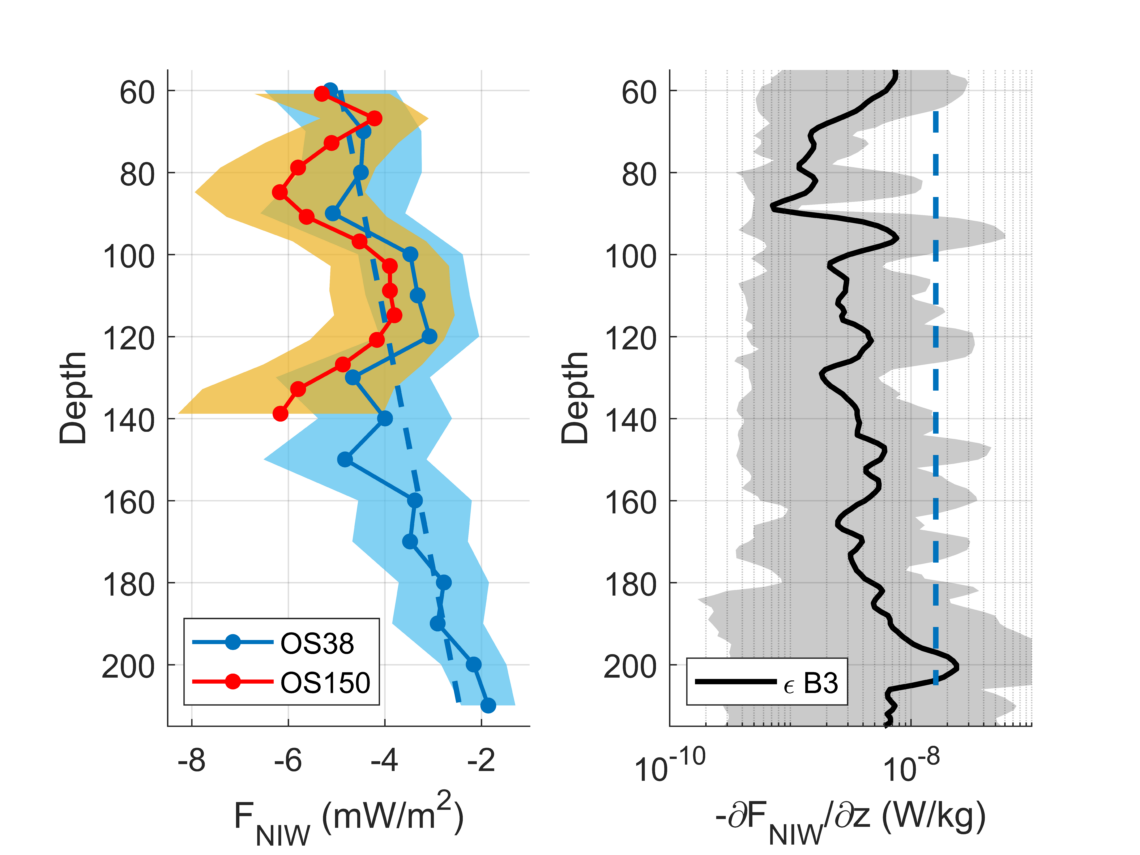
(Left) Ship-ADCP (38kHz) velocities and shear during stations B3. Superimposed on the shear is the dissipation rate of turbulent kinetic energy measured by the Vertical Microstructure Profiler. (Right) Near-inertial wave kinetic energy vertical flux (F_NIW) from Ship-ADCP 38 kHz and 150 kHz velocities measured during station B3. The dotted blue line is a linear fit on the flux from Ship-ADCP 38 kHz. Credits: Rolland et al. 2026.
A new challenge for Earth System Models and global energy budgets
Data from SWOT show that fine scale eddies as the one sampled during the BioSWOT-Med cruise are common in the Northwestern Mediterranean Sea. Before SWOT, all these eddies were not well captured by nadir altimetry (Fig 7 of Rolland et al.). “The process of trapping of near-inertial waves by fine-scale eddies could be widespread in the Mediterranean Sea, and then that its contribution to the turbulence (hence mixing) of the Mediterranean Sea can be significant. From this study it is complicated (if not impossible) to give an estimation, but this work shows that investigating its global contribution is of interest for the Mediterranean circulation” says Rolland.
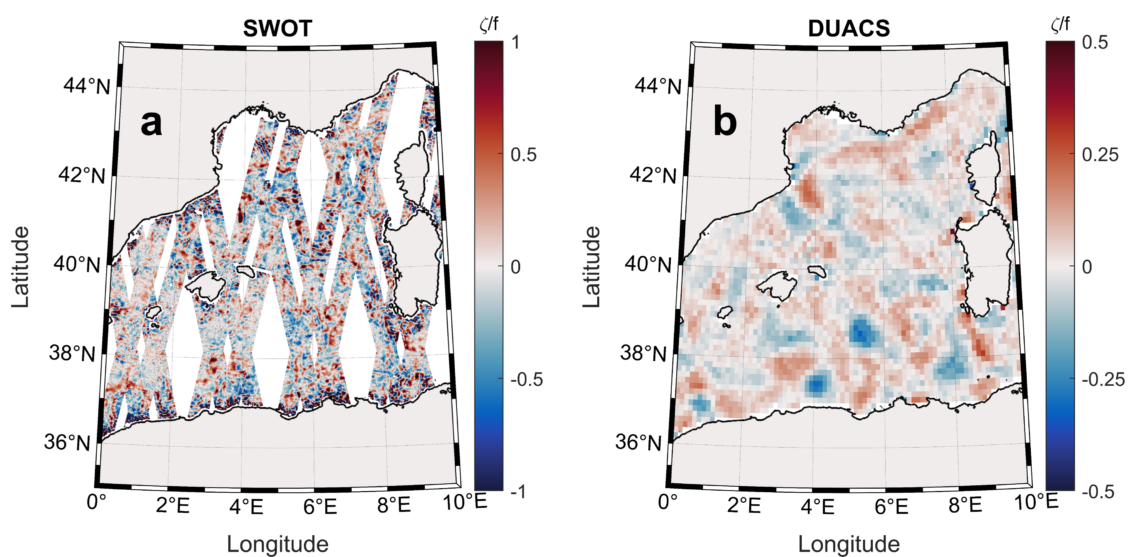
SWOT captures small structures previously elusive to nadir altimetry. (a) SWOT vorticity derived from the SSH using the geostrophic assumption between 20 and 24 August 2023. (b) Gridded nadir altimetry geostrophic vorticity on 22 August 2023. Note the different color scales. Credits: Rolland et al. 2026.
These findings have important implications for the understanding of energy transfer in low to moderate energetic regions – which correspond to the majority of the global ocean – and for investigating how this might change with climate change. “These results suggest the possible existence of a previously underestimated energy pathway connecting wind with the ocean interior and mediated by eddies with a radius of few tens of km. Quantifying and then parameterizing this energy pathway should contribute to the reduction of the incertitude for Earth System Models, in particular in low to moderate energetic regions, and to a better understanding of biogeochemical processes” says Francesco d’Ovidio, senior CNRS researcher at LOCEAN, Paris, and SWOT Ocean PI for CNES.
The work was supported by French spatial agency Centre Nationales Etudes Centre National d’Etudes Spatiales (CNES) and the French National Research Agency (BIOSWOT ANR-23-CE01-0027).
Citation: Rolland, R., Bouruet-Aubertot, P., Cuypers, Y., Bosse, A., Petrenko, A., Maytie, T., et al. (2026). Near-inertial wave trapping inside a fine-scale anticyclonic eddy during the BioSWOT-Med 2023 cruise: Turbulence and energy flux. Journal of Geophysical Research: Oceans, 131, e2025JC022984. https://doi.org/10.1029/2025JC022984
Contact: Robin Rolland (rrolland@uni-bremen.de)
