PhD student working with a new Lagrangian methodology aimed at reconstructing high resolution SST (Sea Surface Temperature) submesoscale fronts with the ultimate goal of estimating the strain field at high resolution.
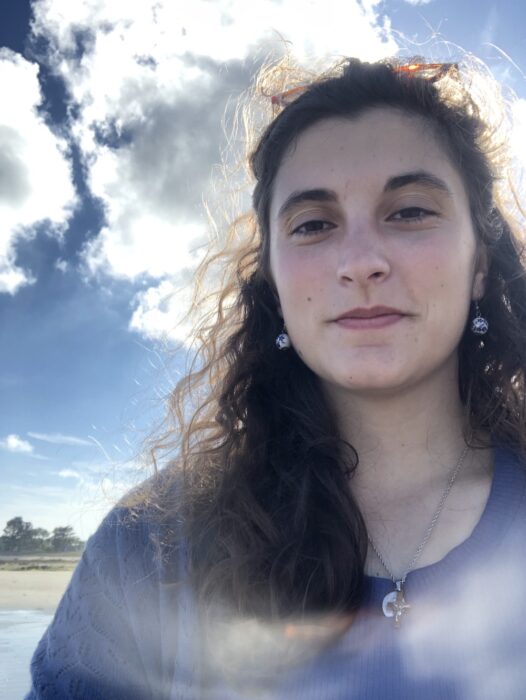
Anastasia Volorio-Galéa has a master’s degree in Physical and Biogeochemical Oceanography from the Mediterranean Institute of Oceanography in Marseille. In 2023 she started a PhD at the Institut Universitaire Européen de la Mer (IUEM) in Plouzané (France) where her work consists in investigating fine scale dynamics in the ocean.
SWOT AdAC: What is your field of research and how did you choose it? Anastasia Volorio-Galéa: The ocean is composed of turbulent structures at many scales, varying from the mesoscale (100km and a few weeks) to the microscale (1m and 1s). In this range lie the submesoscale structures, which are at the heart of my study subject. These structures are known to be highly dynamic areas that capture 50% of vertical movements in the ocean. These motions enable upward nutrient fluxes into the surface layers, which stimulate primary production, a key element of the food web.
The challenges oceanographers are facing rely on the fact that physical and biological processes involved in these structures, are very difficult to observe due to their spatial (1-50 km) and temporal (1-10 days) scales, and this is precisely what caught my interest. I therefore decided to explore this field of research to enhance our knowledge on both submesoscale structures and vertical velocities.
SWOT AdAC: How is your field of research related to SWOT?
AVG: The new SWOT altimetric mission enables us to access the surface dynamic at high resolution over a wide path under the satellite track by providing SSH (Sea Surface Height) measurements at high resolution. However, these SWOT data require to develop new tools to adequately analyze submesoscale structures and more precisely the strain field.
My work relies on the handling of a new Lagrangian methodology aimed at reconstructing high resolution SST (Sea Surface Temperature) submesoscale fronts from SWOT data (geostrophic velocities deduced from SSH) and AMSR-E-like data (SST at low resolution) with the ultimate goal of estimating the strain field at high resolution. The tests are currently performed in the Gulf Stream region but are meant to be extended to other areas of the global ocean.
SWOT AdAC: What do you find exciting about SWOT?
AVG: Prior to the launching of the SWOT mission, scientists would on a regular basis speak of this mission as one-of-a-kind because of its unprecedented resolution with SSH measurements at 5 to 10 km. I ended up discovering on SSH maps, that SWOT data were not only of high quality, but also were exceeding expectations by revealing in some cases, resolution below the km! These high-resolution data are very encouraging to promote our knowledge in ocean science, and this is what I find very exciting with SWOT.
SWOT AdAC: What are your plans after you’ve finished analysing SWOT data?
AVG: On completion of the SWOT data analysis, my goal would be to bridge the gap between submesoscale physical dynamics and biogeochemical interactions, and more precisely, to estimate the surface primary production in submesoscale structures.
As mentioned above, submesoscale structures are known to capture intense vertical motions up to 100 m/day, which is explained by the frontogenesis process. These motions induce a nutrient transport towards the euphotic layer which is essential for photosynthesis, leading to an increase in surface chlorophyll, and subsequently to a stimulation of the primary production, a key element of the food web. It is important for me to add this biogeochemical aspect to my PhD work, a way to loop the loop of my academic background.