Internal solitary waves impact physical and biological processes in the upper ocean, as well as human activities with potential impacts on navigation and coastal infrastructures. For the first time, thanks to the SWOT satellite, it was possible to observe their signature in sea surface height. This allowed researchers to study the interactions of internal solitary waves with eddies on the Amazon Shelf, leading to a better understanding of their complex interactions.
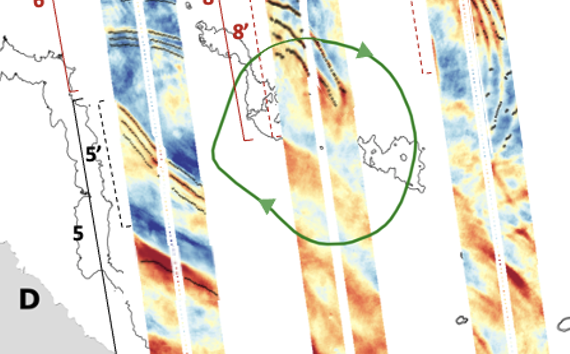
The paper “Internal solitary waves refraction and diffraction from interaction with eddies off the Amazon Shelf from SWOT” published on Ocean Science offers the first observational evidence of refraction and diffraction of Internal Solitary Waves (ISWs) after they have interacted with eddies of different polarity. This was made possible thanks to measurements from the SWOT satellite, that offered for the first time a snapshot of the signature of ISWs in sea surface height, marking a significant advancement in the study of their dynamics.
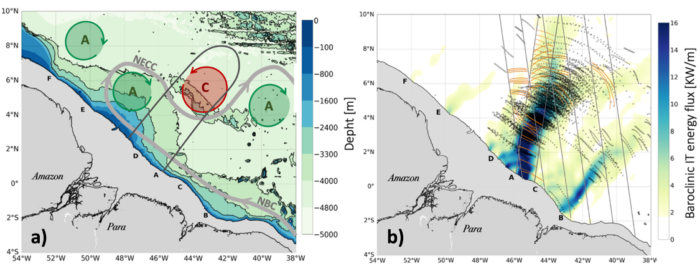
The first panel, (a), shows the bathymetry of the Amazon continental shelf, from the coast down to -5000 m. It highlights the sites where internal tides are generated, labeled A to F along the shelf break. Black contours mark a typical area where internal solitary waves propagate from sites A and D. The main current (the North Brazil Current, NBC) is indicated with thick gray arrows. Cyclonic and anticyclonic eddies are marked with red and green circles, and seamounts are indicated by the 3300 m and 4000 m isobaths.The second panel, (b), is a color map showing the depth-integrated baroclinic internal tide energy flux from the NEMO model for September 2015. It illustrates how the energy radiates from sites A to F along the shelf break. The surface signatures of internal solitary waves detected by MODIS/TERRA satellites are shown as black dotted lines. Credits: Goret et al. 2026.
The interaction between ISWs and eddies
Internal solitary waves (ISWs) often appear as wave packets that can propagate over long distances. They are generated when internal tides propagate into regions of variable stratification or shallow topography or when they encounter other waves or dynamical currents.
The study investigates ISWs detection and the modifications in ISW’s characteristics resulting from interactions with eddies across three contrasting scenarios: ISW propagation in the absence of mesoscale eddies, ISW refraction by a cyclonic eddy, and ISW diffraction by an anticyclonic eddy.
“These contrasting scenarios are important because they show a sample of the diverse responses of internal solitary waves when they encounter eddies of different polarities. The analysis of these scenarios using SWOT observations has also been used to validate realistic hourly simulations about Internal tide and eddies interaction off Amazon shelf” says Chloé Goret, first-author of the study and Oceanographic Data Analysis Engineer at CECI (Climate, Environment, Coupling, Uncertainties) a joint laboratory between CERFACS (Centre Européen de Recherche et Formation Avancée en Calcul Scientifique, located in Toulouse, France), CNRS (Centre National de la Recherche Scientifique) and IRD (Institut de Recherche pour le Développement) in Toulouse, France.
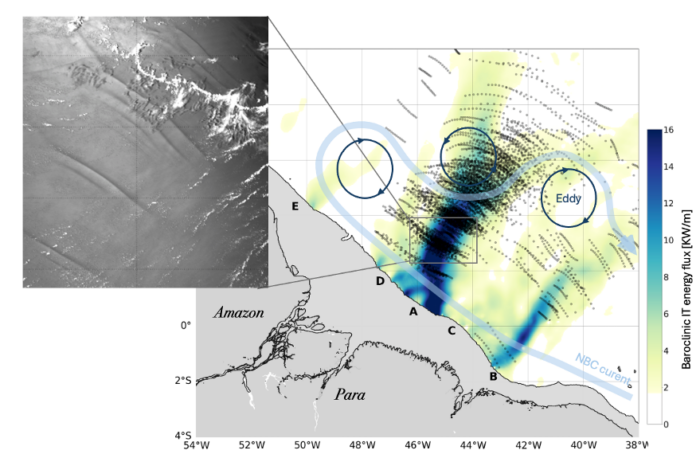
Internal solitary waves on the Amazon continental shelf. The color map represents the depth-integrated baroclinic internal tide energy flux calculated with the NEMO model. The sites where internal tides are generated are labeled A to F along the shelf break. The surface signatures of internal solitary waves (ISWs) detected by the MODIS/TERRA satellite are shown as black dotted lines with (zoom show on left). The main current (the North Brazil Current, NBC) is indicated with thick blue arrows, while cyclonic and anticyclonic eddies are represented by dark-colored circles in ISWs’ pathway. Credits: Goret et al. 2026
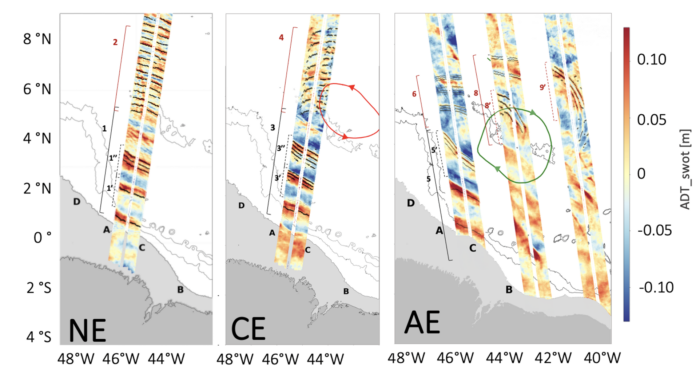
ADT_swot with internal solitary waves detection for (g) NE 14 March 2024 (h) CE 29 September 2023 (i) AE 22 August 2024. NE = no eddy interaction; CE= cyclonic eddy interaction; AE= Anticyclonic eddy interaction. Cyclonic eddies (C) and anticyclonic eddies (A) are marked by red and green circles. Bathymetry is represented using isocontours at -3500, -3000, -100, and 0 m. Credit: Goret et al. 2026
Relevance to society
ISWs impact physical and biological processes in the upper ocean, as well as human activities with potential impacts on navigation and coastal infrastructures. ISWs are associated with strong vertical velocities and intense mixing, which impact the redistribution of physical and biogeochemical properties in the upper ocean. They contribute to energy cascades, air–sea exchanges, and ecosystem structuring.ISWs also pose risks to offshore operations by destabilizing underwater structures and threatening navigation safety.
A better understanding of ISWs–eddy interactions is thus essential for ocean energy budgets and hazard assessment, as eddies can transfer energy to higher modes and generate wave interference. “Understanding how the energy transported by internal solitary waves is redistributed, transformed, or dissipated when interacting with eddies is essential for developing robust parameterizations in climate models. Furthermore, identifying and predicting the trajectories of internal solitary waves and the associated mixing is important for fisheries, the transport of pollutants as well as assessing operational risks for offshore platforms and navigation” says Goret.
Citation: Goret, C., Koch-Larrouy, A., Kouogang, F., de Macedo, C.R., M’Hamdi, A., Magalhães, J.M., da Silva, J.C.B., Tchilibou, M., Artana, C., Dadou, I. and Delepoulle, A., 2026. Internal solitary waves refraction and diffraction from interaction with eddies off the Amazon Shelf from SWOT. Ocean Science, 22(1), pp.679-698. https://doi.org/10.5194/os-22-679-2026
Contact: Chloé Goret (goret@cerfacs.fr)
