Post-doctoral researcher investigating tidal dynamics across the land-ocean zone.
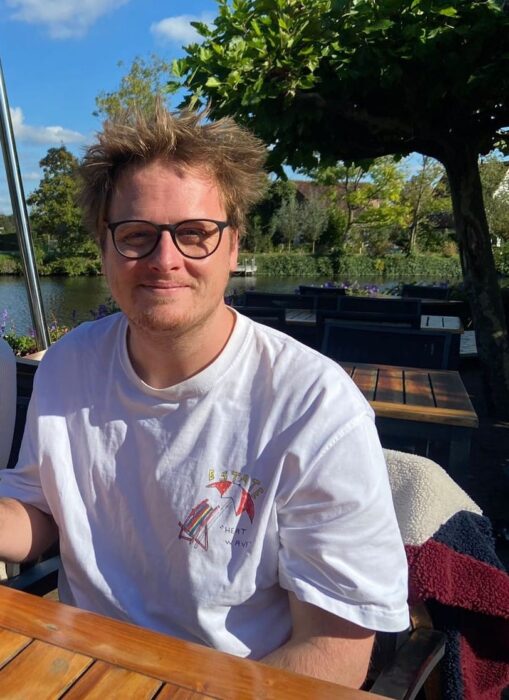
Michael Hart-Davis got a Master’s of Science in Physical Oceanography at the Nelson Mandela University in South Africa. After that, he completed my PhD in Satellite Altimetry at the Technical University of Munich focusing on the development of a global ocean tide model for application in satellite altimetry and numerical modelling. Since completion, he has been working as a Post Doctoral researcher in Satellite Oceanography, investigating tidal dynamics across the land-ocean zone.
SWOT AdAC: What is your field of research and how did you choose it?
Michael Hart-Davis: My field research mainly focuses on physical oceanography using satellite altimetry, numerical modelling and in-situ measurements. My career can be split into two aspects that I am continuously passionate about, ocean tide modelling and Lagrangian ocean modelling.
The focus of Lagrangian ocean analysis was to utilize satellite ocean products and numerical modelling to study cross-disciplinary applications, including search and rescue and juvenile turtle modelling. This research continues to excite me as it allows me to collaborate with incredible scientists from a variety of scientific disciplines, including geneticists, marine biologists and operational salvage companies.
My main research passion is ocean tides and the role they play in global circulation, particularly in the coastal zone. Ocean tides are quiteMi interesting, they have been studied for centuries with great minds in scientific history tackling the topic, including Aristotle and Newton. Despite this, we are still learning more about ocean tides today, particularly thanks to the launch of modern satellite altimetry. The complexities and intricacies of tides across the land-ocean zone fascinates me. My current research has used SWOT from both the Cal/Val and Science orbit in complex regions to advance the understanding of the spatial variability at unprecedented scales. The idea behind this research is to exploit the wide variety of SWOT products, both ocean and inland, to advance the understanding of ocean tides and their role within estuaries and fjords, and use this to inform the ocean tide models we develop to serve the SWOT community.
SWOT AdAC: How is your field of research related to SWOT?
MHD: My research aims to assess and exploit SWOT to study ocean tides and their role in ocean dynamics. Additionally, as an ocean tide modeler I would like to provide the community a global tide model that can be used to account for tidal variability in the coastal region to extend the usability of SWOT for studies of non-tidal processes.
SWOT AdAC: What do you find exciting about SWOT?
MHD: It goes without saying that the spatial coverage that SWOT provides is revolutionary for oceanic research. But what excites me is the new areas of research that have opened up that allow us to explore dynamical interactions between oceanographic and hydrological processes. The more we continue to get our hands on SWOT data and the longer the satellite orbits, the more ideas and avenues of research we are opening.
SWOT AdAC: What are your plans after you’ve finished analysing SWOT data?
MHD: I do not plan to stop analyzing SWOT! I think the future is bright and the more SWOT data we get (and the longer SWOT hopefully orbits for) and the more data we start to couple with SWOT, the cooler science we can do!