Physical oceanographer focusing on the development of reconstruction methods of sea surface height (SSH) from satellite altimetry measurements.
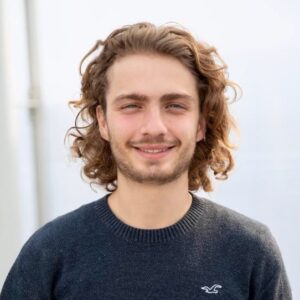
Valentin Bellemin-Laponnaz graduated in 2022 with a double degree in Remote Sensing Engineering and Climate Dynamics from ISAE-SUPAERO and Université Paul Sabatier (France). He later completed a PhD in Oceanography at Université Grenoble Alpes (France), within the Institute of Environmental Geosciences (IGE), which he defended in early 2026.
SWOT AdAC: What is your field of research and how did you choose it?
Valentin Bellemin-Laponnaz: My research focuses on the development of Sea Surface Height (SSH) reconstruction methods from satellite altimetry measurements, including data from the new SWOT mission. Since satellites do not observe the ocean surface at all locations and times, it is difficult—or even impossible—to fully track the evolution of ocean features. To address this, a reconstruction step is required to fill the gaps between available satellite measurements and generate complete SSH maps over specific regions.
My first experience with SSH reconstruction methods was during my master’s thesis at Collecte Localisation Satellites (CLS, France) in 2021–2022. At that time, operational reconstruction processes needed to be prepared for the arrival of SWOT data, a project to which I contributed. I discovered the complexity of SSH reconstruction and became particularly interested in the challenge of improving the accuracy of SSH maps. This led me to pursue a PhD focused on the development of innovative reconstruction methods, specifically designed for SWOT data.
SWOT AdAC: How is your field of research related to SWOT?
Valentin Bellemin-Laponnaz: SWOT ‘s new technology enables the observation of fine-scale processes that were previously not properly detected by other types of satellite missions. It gives access to a wide range of physical processes, the two main ones being balanced motions and internal tides. These two processes are fundamentally different; for instance, the latter is a wave and evolves much faster than the former. It is therefore necessary to reconstruct these processes separately and to produce distinct SSH maps for each of them. SWOT measurements are not frequent enough to identify the two processes based solely on their temporal characteristics. The exploitation of SWOT data thus raises a major challenge, which my research aims to address: the separation and reconstruction of balanced motions and internal tides.
SWOT AdAC: What do you find exciting about SWOT how do you contribute to the analysis of the data collected?
Valentin Bellemin-Laponnaz: The wide diversity of ocean surface processes that researchers can now access thanks to SWOT is remarkable. However, it raises the fundamental challenge of identifying and reconstructing each of these processes in order to study them properly. These processes are expected to play an important role in global ocean circulation and in its impact on climate and marine biodiversity.
SWOT AdAC: What are your plans after you’ve finished analysing SWOT data?
Valentin Bellemin-Laponnaz: Even once the solution for properly reconstructing and separating balanced motions and internal tides has been developed, the work will not be complete. Other dynamical processes remain, that cannot yet be clearly identified or reconstructed, such as internal solitary waves and fine-scale features known as submesoscales. There will therefore always be room for further improvements in the exploitation of SWOT data.
SWOT AdAC: Besides SWOT, are you involved in another exciting research and do you want to share something about it?
Valentin Bellemin-Laponnaz: In addition to my research activities, I am actively involved in science outreach, aiming to raise awareness of the importance of ocean observation in the context of global warming. I particularly enjoy developing innovative activities for schools and the public, such as a “meal&conference’’ event where live experiments are reproduced on the plates and participants can taste them.
Campaign / Project: SWOT Data Assimilation Working Group