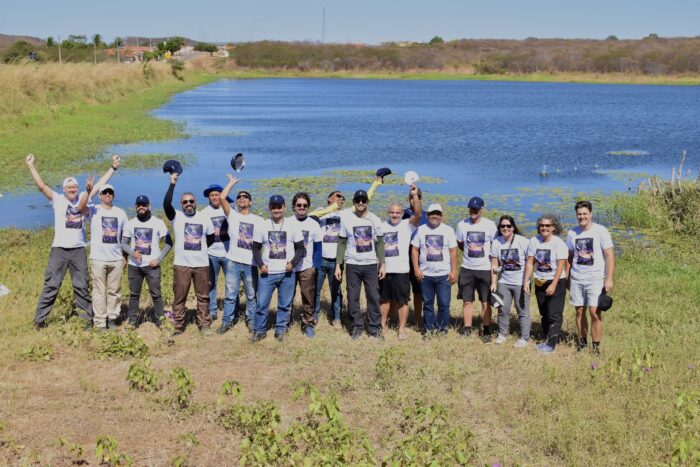
Hydrologist using SWOT data to study water availability in the semiarid region of Ceará in Brazil.
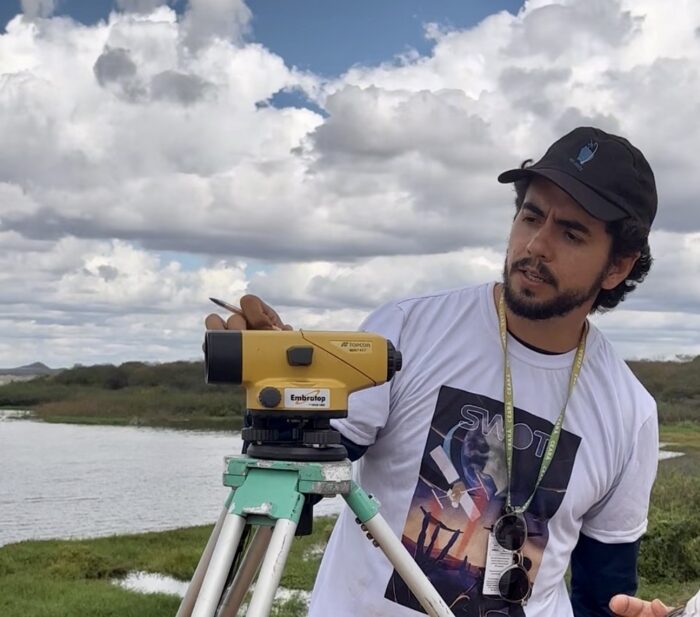
Before starting his PhD journey, Rafael Reis Alencar Oliveira spent nearly ten years working within the Water Management System of the State of Ceará in Brazil. He first joined as a technician, supporting the operational side of the system, and later became a researcher at FUNCEME – the Ceará Foundation for Meteorology and Water Resources. FUNCEME plays a central role in producing scientific information that guides decision-making in statewide water management. It was through the close collaboration between FUNCEME and the Federal University of Ceará that the idea of pursuing a PhD emerged, eventually leading to a joint-supervision agreement with the University of Toulouse in France and IRD / GET collaboration.
SWOT AdAC: What is your field of research and how did you choose it?
Rafael Oliveira: Over the course of my professional experience, I naturally specialized in hydrology and water resources management field, as well as in improving my capacity to observe and understand the Earth through complex spatial datasets. Little by little, I developed a set of complementary skills that strengthened this path, from topographic and bathymetric surveys for in situ monitoring of reservoirs, to the use of satellite remote sensing for assessing environmental conditions and potential impacts. I also increasingly incorporated data science and programming into my work, allowing me to integrate these diverse sources of information into more robust analyses.
SWOT AdAC: How is your field of research related to SWOT?
RO: In the Brazilian semiarid region, water availability is naturally limited, and much of the supply depends on storing seasonal rainfall in artificial reservoirs. In Ceará, for example, the majority of the thousands of reservoirs mapped are smaller than five hectares, what makes systematic monitoring a major challenge. Understanding their dynamics and storage capacity is therefore a central element of water management in our region.
This is where SWOT becomes especially important for us. The radar interferometric altimetry mission brings the first high-resolution, global survey of surface water bodies, with a level of very impressive accuracy. For a region that relies so heavily on small reservoirs, this technology opens a completely new window for understanding water availability.
My research connects directly with this potential. Through the creation of the Ceará SWOT Cal/Val site, and thanks to strong institutional collaboration and intensive field campaigns, we were able to build a very rich in situ dataset to support the mission. This allows us not only to compare our measurements with SWOT observations, but also to think about how these results could eventually be used for operational monitoring of reservoirs across the state.
SWOT AdAC: What do you find exciting about SWOT and the SWOT campaign during the fast-sampling phase in which you participated? How did you contribute to the campaign and to the analysis of the data collected?
RO: It was especially exciting to see how the mission’s objectives aligned so closely with the realities of Ceará, and to experience all of this during my PhD period. Since the SWOT Cal/Val orbit passed directly over part of the State, we selected several reservoirs that matched both the scientific requirements of the mission and the practical needs of local water management. We instrumented and monitored them in the field with extremely high accuracy, which gave us the opportunity to evaluate SWOT observations at a very detailed level in both the Cal/Val and the scientific phase.
I coordinated all field missions conducted so far at our site, from installing and maintaining the monitoring systems to collecting data at high temporal and spatial resolutions. In collaboration with partner institutions also involved in the field activities, we processed and integrated this information into a unified database that can serve both the mission and broader scientific and operational interests.
SWOT AdAC: What are your plans after you’ve finished analyzing SWOT data?
RO: At the moment, I am fully dedicated to processing SWOT data for our region and carrying out detailed comparisons with our in situ observations. Once I complete this phase, my next steps are to expand the analysis toward more complex hydrological questions. I am particularly interested in investigating basin-scale water balance, exploring how different hydrological structures and management practices influence water dynamics, examining long-term water level changes, and assessing potential impacts of climate variability and change.
SWOT is still a very young mission, and its range of possible applications is remarkably broad. With the potential extension of the mission in the future, or the adoption of similar wide-swath altimetry technologies in upcoming satellites, new opportunities will continue to emerge. I hope to keep deepening my work with this type of sensor, either through a postdoctoral position or through collaborative research projects, including international partnerships.
SWOT AdAC: Besides SWOT, are you involved in another exciting research and do you want to share something about it?
RO: Working with SWOT has opened the door for me to engage in other exciting research projects related to water resources. One of them is a collaboration between the Federal University of Ceará and the University of Brasília on the project “Contributions of Socio-hydrology to Water Management in the Context of the Water–Energy–Food Nexus.” Supported by CAPES and FUNCAP, this initiative aims to evaluate and design adaptive and integrated management pathways that can improve water allocation and help reduce conflicts over water use.
I am also involved in the IRAACEMA project (Innovation for the Remote Analysis of AÇudes, Surface Estimation and Monitoring using Artificial Intelligence and Satellite), which receives support from the IRD. This project builds directly on the dataset we developed at the SWOT Ceará Cal/Val site and focuses on creating machine-learning tools to generate consistent and reliable information for analyzing surface water bodies.
Campaign / Project: Use of SWOT data to improve monitoring of small reservoirs in the northeast of Brazil